An emergency advanced life support ride would go from $1,000 to $1,200 on Dec. 1, the first rise since 2023. Commissioners take a final vote Monday, Nov. 9.
An emergency ambulance ride from the Mt. Juliet Fire Department would cost $1,200 starting Dec. 1, up from $1,000. Every transport rate in the city’s fee schedule would rise, and the city could bill for two kinds of call it has no charge for today.
The Board of Commissioners passed the new rates on first reading Monday, Oct. 26, according to the city’s legislative record. The final vote is set for Monday, Nov. 9, after a public hearing at 6:15 p.m. at City Hall, 2425 N. Mt. Juliet Road, according to the city’s hearing notice.
What would change
The base rates per trip, from the department’s proposed rate sheet:
| Service | Now | From Dec. 1 |
|---|---|---|
| Advanced life support, emergency | $1,000 | $1,200 |
| Advanced life support, non-emergency | $922.70 | $1,000 |
| Advanced life support, level 2 | $1,160 | $1,500 |
| Basic life support, emergency | $785 | $900 |
| Basic life support, non-emergency | $690 | $725 |
| Specialty care transport | $1,335 | $2,000 |
| Mileage, per mile | $16 | $18 |
| Treated on scene, not taken to the hospital | no charge listed | $250 |
| Lift assist | no charge listed | $100 |
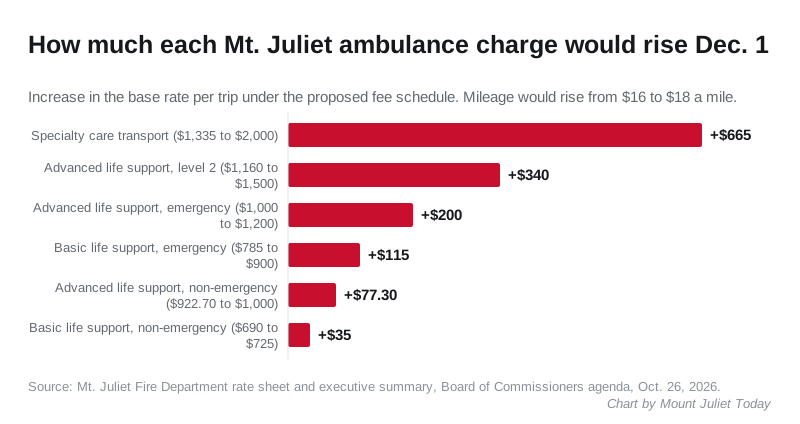
The biggest rise in dollars is for specialty care transport, up $665. Advanced life support at level 2 goes up $340.
Why the city says rates are rising
The fee schedule has not changed since the city started providing its own EMS in March 2023, according to the fire department’s summary for commissioners. The city’s billing company, Ambulance Medical Billing, recommended the update to keep the rates at market value, the summary says.
The two new charges follow a change in what payers cover. TennCare, the state’s Medicaid program, and private insurers now pay for some calls that do not end with a trip to the hospital, the department said. Those include treating a patient and releasing them at home, and public assist calls. The current schedule has no way to bill for them.
The change costs the city nothing to put in place and will raise its ambulance billing revenue, the summary says. It does not estimate by how much. Fire Chief Mark Foulks prepared it.
How Mount Juliet compares
The department compared its rates with 24 other ambulance services. The comparison sheet attached to the ordinance does not name them. Before the change, Mount Juliet charged less than their average on every line, according to the comparison sheet.
After the change, the city would sit close to that average on most rates:
- Advanced life support, emergency: $1,200, against an average of $1,154.49
- Basic life support, emergency: $900, against $907.82
- Mileage: $18, against $19.46
- Specialty care transport: $2,000, against $1,650.85
Also before commissioners Nov. 9
Three other fire department measures passed first reading Oct. 26 and come back for a final vote the same night:
- A federal grant for Fire Station 1. The department won a $94,000 Assistance to Firefighters Grant: $85,454.54 in federal money and an $8,545.46 city match. It will pay for vehicle exhaust systems, a fire sprinkler system and a fire alarm system at the station on Belinda Parkway, according to the grant ordinance. The city has already set aside $700,000 to renovate the station. The work goes out to bid in the next few weeks and should take six to eight months, the department’s summary says.
- A late bill for traffic signal equipment. The city owes $147,787 to Miovision for equipment that lets fire trucks change traffic lights on approach. The department accepted the project in late November 2025, but the company did not send its invoice until September 2026, after the budget year had closed, according to the department’s summary. The budget amendment moves the money from the city’s fund balance.
The same hearing covers a land use change for downtown parcels on West Caldwell Avenue and Third Avenue, and one for 1271 E. Division St. Our public notices guide lists the city’s posted hearings.
What it means for you
- If you call 911 for a medical emergency on or after Dec. 1, the bill for the ride would be higher. What you pay yourself depends on your insurance, Medicare or TennCare coverage.
- If paramedics treat you at home and you do not go to the hospital, a $250 charge could appear for the first time. A lift assist call would carry a $100 charge.
- To speak on the rates, go to the public hearing at 6:15 p.m. Monday, Nov. 9, at City Hall. The regular meeting starts at 6:30 p.m. and streams on MJTV, the city’s channel. You can also contact your commissioner; our city hall contacts page lists them.
Have your say